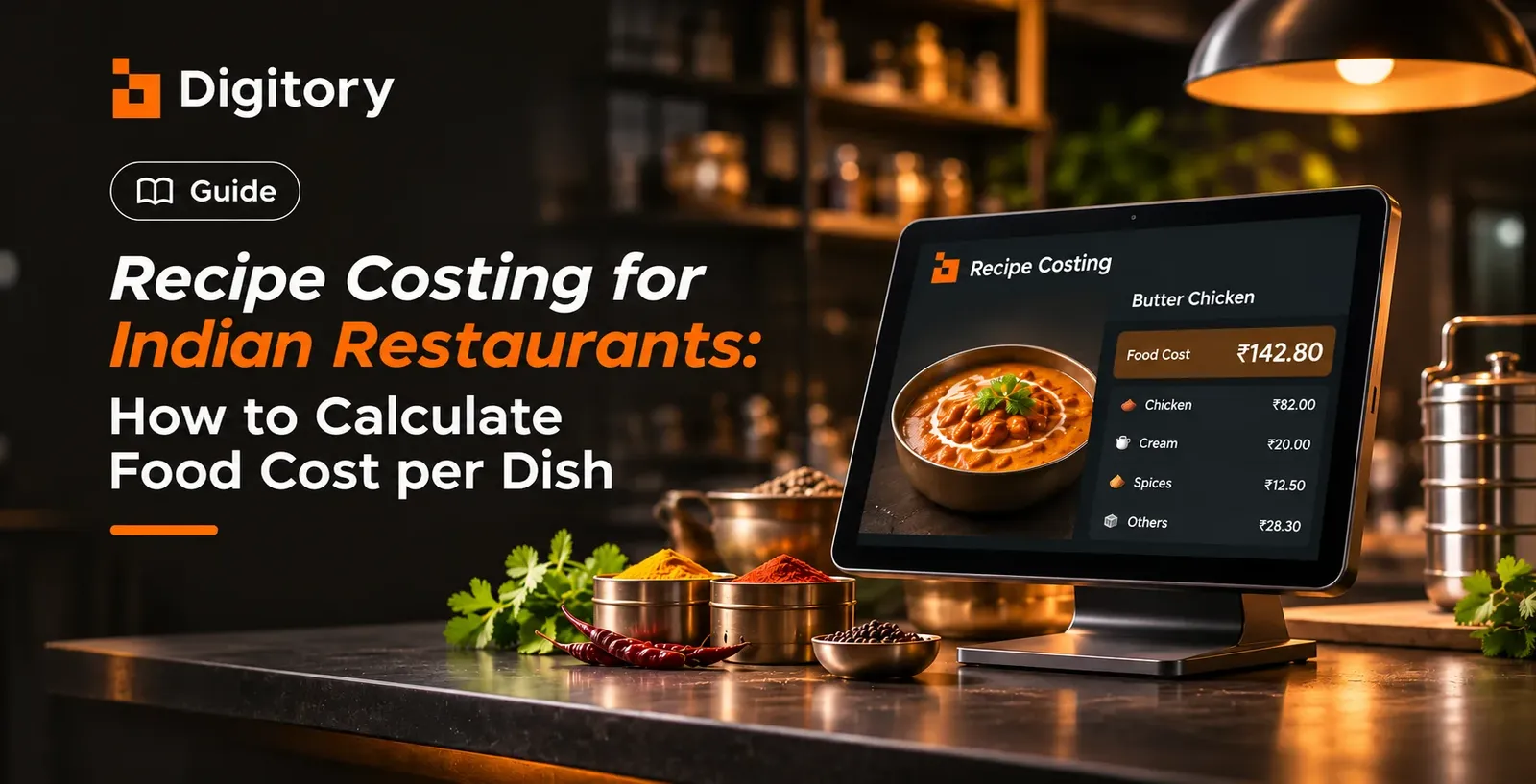
Recipe Costing for Indian Restaurants: How to Calculate Food Cost per Dish
A step-by-step guide to costing every dish and drink on your menu: the formula, yield, sub-recipes, a worked example, and how often to update costs.
Recipe costing means working out what the ingredients in one portion of a dish cost you. It helps you price the dish for profit and notice when that cost goes up. To do it, list every ingredient in the recipe with its quantity per portion and adjust for trimming and cooking loss. Then multiply by what you actually paid your supplier, and divide the total by the menu price to get your food cost percentage.
On paper, that is simple. In an Indian kitchen, the hard part is keeping the numbers right. Vendor prices change every week, chefs change recipes without telling anyone, and the same paneer goes into six dishes. This guide covers the method and a worked example. It also shows how to keep your costs up to date without spending every Sunday on a spreadsheet.
What is recipe costing and why does it matter?
A recipe cost, also called a plate cost, is the ingredient cost of one serving. Food cost percentage is that number divided by the selling price. If a dish costs you ₹90 in ingredients and sells for ₹300, its food cost is 30%.
It matters because most restaurants price a dish once, when the menu launches, and never check it again. Meanwhile, the price of onions, tomatoes, cooking oil, dairy and imported liquor can change a lot from month to month. A dish that made good money in January can be losing money by June, and nobody notices. Recipe costing replaces guesswork with a number you can check.
It also helps with stock control. Once you know how much of each ingredient a dish should use, you can compare what you sold with what left the store and see where the gap is.
How do you calculate the food cost of a dish?
Follow these five steps for every dish on the menu.
- Write down the standard recipe. List every ingredient for one portion, in grams, millilitres or pieces. Include the garnish, oil, masala and any side or chutney that goes on the plate.
- Use your real purchase price. Take the price from your latest supplier invoice, not a price you remember. Convert it to a cost per gram or per millilitre. For example, ₹480 per kg of paneer is ₹0.48 per gram.
- Adjust for yield. Most raw ingredients lose weight when you clean, trim or cook them. If 1 kg of whole chicken gives you 700 g of usable meat, divide the purchase price by 0.7 to get the real cost per usable gram.
- Add it up. Multiply each ingredient’s quantity by its yield-adjusted cost, then add up all the lines. That total is your plate cost.
- Divide by the selling price. Plate cost ÷ menu price (before tax) × 100 = food cost percentage.
The formula is: Food cost % = (ingredient cost per portion ÷ selling price) × 100
What does a worked recipe costing example look like?
Here is a sample for one portion of paneer tikka. The prices and quantities are only examples, so use your own invoices and recipes.
|
Ingredient |
Quantity per portion |
Purchase price |
Yield |
Cost per portion |
|---|---|---|---|---|
|
Paneer |
180 g |
₹480 per kg |
95% |
₹90.95 |
|
Hung curd |
40 g |
₹200 per kg |
100% |
₹8.00 |
|
Capsicum and onion |
60 g |
₹80 per kg |
85% |
₹5.65 |
|
Tikka masala and spices |
10 g |
₹600 per kg |
100% |
₹6.00 |
|
Oil and butter |
15 ml |
₹180 per litre |
100% |
₹2.70 |
|
Mint chutney and salad |
1 side |
Sub-recipe |
n/a |
₹7.00 |
|
Plate cost |
|
|
|
₹120.30 |
If the menu price is ₹380 before tax, the food cost is ₹120.30 ÷ ₹380 × 100, or about 31.7%. If paneer goes up to ₹540 per kg, the paneer line rises to about ₹102.30. The plate cost becomes about ₹131.67 and the food cost about 34.6%, even though nobody touched the menu.
Look at the chutney line. Cost sauces, gravies, marinades and bases once, as sub-recipes, for example the cost per gram of makhani gravy. Then use that cost in every dish that needs it. That way, one price change updates every dish on its own.
What do most restaurants miss in recipe costing?
- Yield and wastage. Trimming, bones, peel, liquid that boils off, and spillage. If you skip yield, every protein and vegetable will look cheaper than it really is.
- Garnish and sides. Papad, onion rings, lemon, chutneys, the dip that comes with fries. Each is a small cost per plate, but it adds up over a month.
- Cooking oil and ghee. Often left out because it is hard to measure. Estimate it per portion and check it against your monthly usage.
- Packaging for delivery. For Swiggy and Zomato orders, the container, bag and cutlery are part of the cost of that order.
- Bar measures. For cocktails, cost each spirit by the peg (30 ml or 60 ml) from the bottle price. Include mixers, garnish, and ice if you buy it.
- Staff meals and complimentary portions. These are not part of plate cost. Track them separately so they don’t show up as gaps you can’t explain.
How often should you update recipe costs?
Update a recipe cost whenever one of three things changes: the supplier price of a main ingredient, the recipe or portion size, or the selling price. In practice, that means:
- With every purchase for fast-moving perishables, proteins, dairy and liquor, if your system can update prices from purchase entries.
- Every month, at the least, for your best-selling dishes and anything with a high food cost.
- Before every menu change, so new prices are based on today’s costs.
A spreadsheet works for one small outlet with a short menu. It stops working once you have many dishes, several vendors, a central kitchen or more than one outlet. At that point, every price change has to be typed into many places by hand.
Spreadsheet or recipe costing software: which is right for you?
|
Question |
Spreadsheet |
Recipe costing in your inventory software |
|---|---|---|
|
Where do ingredient prices come from? |
Typed in by hand |
Taken from purchase orders and supplier invoices |
|
What happens when a price changes? |
Someone has to update every affected recipe |
Every recipe using that item recalculates |
|
Can you compare expected and actual usage? |
Only with a lot of manual work |
Yes, sales from billing are matched against recipes and stock |
|
Sub-recipes and central kitchens |
Possible but fragile |
Built in, including transfers between kitchens |
|
Best for |
One outlet, small menu, owner-run |
Busy kitchens, bars, multiple outlets, chains |
How does recipe costing help control stock and pilferage?
Once every dish and drink has a standard recipe, your billing tells you how much of each ingredient should have been used. Your stock count tells you how much actually was. The difference is variance. Some variance is normal (spillage, tasting, a dropped tray). Large or repeated variance on the same item usually points to over-portioning, wrong recipes, unrecorded wastage, or theft.
For bars this matters even more, because liquor is expensive and easy to over-pour. Costing every cocktail and peg against the bottle, and comparing sales with closing stock, is the basis of bar stock control. We cover that in detail in our guide on controlling liquor pilferage and bar stock variance.
How do you use recipe costs to price your menu?
Recipe costing tells you what a dish costs. Pricing also depends on what guests will pay, what nearby venues charge, and how the dish sells. A practical approach:
- Decide a target food cost range for each category (starters, mains, desserts, cocktails). Your accountant or past results can guide this.
- Flag dishes that sit well above the target. Rework the recipe, change the portion or supplier, or raise the price.
- Look at contribution in rupees as well as the percentage. A dish with a higher food cost percentage can still earn more per plate if it sells at a higher price.
- Pair this with sales data. Popular dishes with good margins deserve the best spot on the menu. Our guide to menu engineering explains how.
How Digitory helps
Digitory is an AI-powered restaurant platform used by 600+ clients across India, Thailand and Trinidad and Tobago, including breweries, pubs, cafés, fine dining, cloud kitchens and chains. Recipe costing is part of Digitory's AI inventory and purchasing, alongside live stock, purchase orders, vendor prices, bar stock in pegs and bottles, and central kitchen transfers. Because billing, kitchen display and inventory run in one system, sales are matched against your recipes, so you can see expected and actual usage side by side.
If you would rather not run stock control yourself, Digitory Managed Inventory puts experts in charge of it for you. You can also ask the DigiTalk AI assistant questions about your live reports.
To see recipe costing on your own menu, book a demo or WhatsApp us on +91 70225 11122.
Frequently asked questions
What is a good food cost percentage for a restaurant in India?
There is no single right number. It depends on your format, menu and prices: a bar, a fine-dining restaurant and a cloud kitchen will each have different targets. Set a target per menu category based on your own past results, then track each dish against it.
What is the difference between recipe costing and food cost?
Recipe costing is the cost of the ingredients in one portion of one dish. Food cost usually means your total ingredient spend for a period divided by your food sales for that period. Recipe costing is the plan; actual food cost shows how closely the kitchen followed it.
Should I include GST in recipe costing?
Calculate plate cost using what the ingredient really costs you after any tax you can or cannot claim back, and compare it with the menu price before tax charged to the guest. How GST applies depends on your registration and outlet type, so confirm the treatment with your accountant.
What is yield in recipe costing?
Yield is the share of an ingredient you can actually use after cleaning, trimming or cooking. If you buy 1 kg of onions and 900 g is usable after peeling, the yield is 90%. Divide the purchase price by the yield to get the true cost of what goes on the plate.
How do I cost a cocktail or a peg?
Divide the bottle price by the number of pegs it holds to get the cost per peg, then add mixers, syrups, garnish and any other ingredients. Use the same measure your bar actually pours, and recheck the cost when the bottle price changes.
Can recipe costing software work with my POS?
It works best when it does. When recipes are linked to billing, every sale reduces stock by the recipe quantity, and you can compare expected usage with your stock count. Digitory runs POS, kitchen display and inventory in one system for this reason.